There is a harmonium in our museum. Most people walk past it. It looks like an old wooden box with keys, and next to a charcoal iron and a set of brass scales it does not shout for attention.
But of everything in that room, it is the one I most like to stop at.
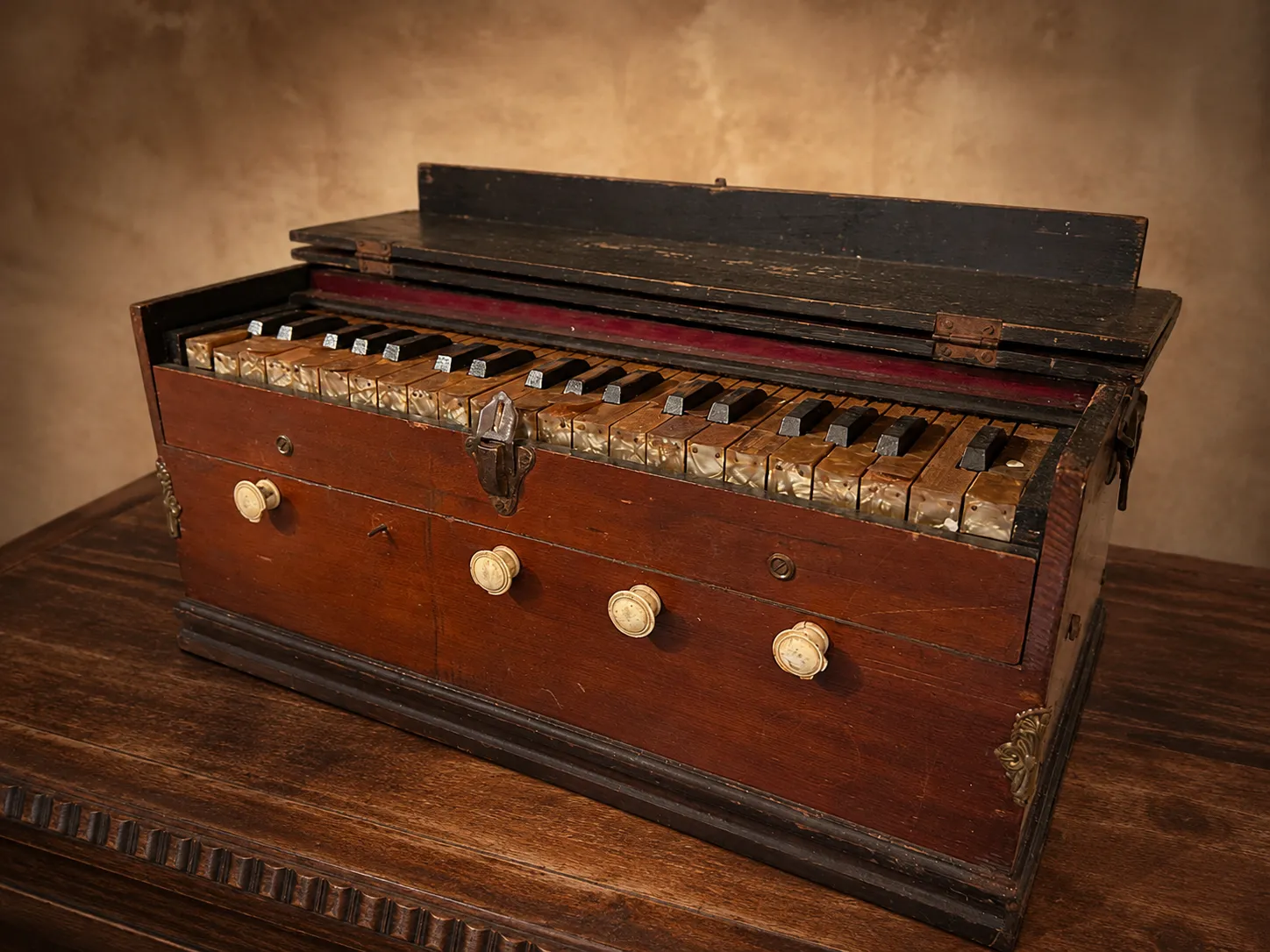
It came here in somebody’s luggage
When our ancestors came to this island as indentured labourers, from Bihar and the eastern part of Uttar Pradesh, they could not bring much. A trunk, if they were lucky. So what they brought was what they could not leave behind.
Some brought cooking vessels. Some brought seeds. Somebody in our family brought a harmonium.
Think about that for a moment. A man boards a ship not knowing what is waiting at the other end, and he decides the thing he cannot live without is an instrument. Not a tool. Not something to sell. Something to make music with.
It was passed down until it reached my grandfather. And he played it at weddings.
A wedding was built by the village
To understand what that meant, you have to understand how a wedding happened here back in the days.
Nobody hired anybody. There was no contractor. You did not rent a hall or a marquee to fit the crowd. There was no caterer arriving in a van.
If a family in the village was marrying, the village made the wedding.
The men went out and cut bamboo, and with that bamboo they built the tent the wedding would take place under. The women came to the house and ground the spices by hand, on stones like the one we still grind on here. People went down to the river to clean the fish and the meat. Then the cooking started, and it was neighbours doing it, not strangers.
On the day, the same people served the food.
And that is why the whole village came to every wedding. Not out of politeness. They came because they had built it. The invitation was not a card. The invitation was the bamboo you cut and the fish you cleaned.
Friday, then Saturday
The Geet-Gawai was the Friday.
That is the women’s evening. Married women sorting turmeric and rice and money in a cloth, the dholak drum going, singing that carries on late into the night. It is the oldest part of the whole thing, brought over by the women who came from India, and it is now recognised by UNESCO, inscribed in 2016 on the list of the world’s intangible cultural heritage.
The Saturday was the haldi. The turmeric ceremony itself.
And after the haldi, after everybody had eaten, that is when the gamat began.
Then the harmonium started
Gamat is our own thing.
The songs came from Bhojpuri, brought over with everything else. But what this island did with them is different. The men made fun of things. Of the families, of the guests, of each other. Somebody sitting there eating would suddenly hear a verse about himself, and everybody would laugh, and he would wait for his chance to get his own back.
The haldi is sacred. Drink was not served at it, and it was not something guests were offered. But the men who sang kept a bottle of rum among themselves, out of sight, and it was passed quietly between them. Nobody made a display of it. It stayed where it belonged, behind the singing.
The harmonium started. The men sang.
It went on for hours. Sometimes until one o’clock in the morning. A crowd would gather round and it turned into a show, a proper show, the kind you did not buy a ticket for and could not book, because it only existed while those particular men were sitting together.
I was very small. But I remember the sound of it, and I remember that nobody wanted to go home.
Not everybody could do it
This is what people forget. Gamat was not something anyone could stand up and do.
You needed a voice. You needed to know the songs. And more than either of those, you needed to be quick, because the best of it was made up on the spot. A man who could take what was happening in front of him and turn it into a verse while the crowd was still laughing at the last one was worth a lot on a Saturday night.
There were only a few men in any village who could really do it. They were known. People would ask whether so-and-so was coming, and if he was, they stayed.
My grandfather was one of them. He had the instrument, he had the voice, and he had the timing.
Something I only learned later
Here is something I did not know when I was young.
Gamat, in the form it took here, exists nowhere else. There are cousins of it in Trinidad, in Guyana, in Suriname, in Fiji, in South Africa, wherever the Bhojpuri families were sent. But what developed on this island is its own thing. The mockery, the improvising, the shape of the evening. That is Mauritian.
And there is something else, which matters to me because of what we do here.
Before any of it, when the women were grinding the spices by hand for the cooking, they sang too. Those grinding songs have a name, jatsar, and they were sung at the stone. Long songs, often sad ones, about daughters-in-law and the lives they had been given.
So the music did not start when the harmonium came out on the Saturday. It started days earlier, at the grinding stone, with the women.
I think about that every time a guest laughs at the ross cari because their arms are tired. That stone had songs of its own.
What went quiet
Weddings are still weddings. But the tent goes up on metal poles now, brought in and put together by a company. The food comes from a caterer. The music comes from speakers. All of that is easier, and nobody who did it the old way would tell you it was not hard work.
What went is the reason everybody was there. When the village builds the wedding, the village owns the wedding. When you pay for it, you have guests instead.
And gamat went with it. You will not hear it at a wedding today. The men who could do it properly are mostly gone, and the songs were never written down, because nobody thought they needed to last past the night they were sung in.
Why the harmonium is in the museum
We did not put it there because it is old.
We put it there because it crossed an ocean in somebody’s hands, and then it was played in a bamboo tent, in a village, at one o’clock in the morning, while people who had cooked the food together laughed at songs about themselves.
When you come and stand in front of it, that is what you are looking at. You can read more about the museum, or about our family and the land this house was built on.
The harmonium is in the museum
It sits in the heritage museum, a few steps from the grinding stone the women sang at. Visits begin at 09:00, 11:00, 13:00, 15:00 and 17:00, every day.
Come and see it today
MUR 200
Museum, grinding demonstration, herbal tea and the boutique.
MUR 375
Museum, ancestral kitchen, spice garden, hand-grinding and tastings. Children MUR 200.
Daily
Last entry 17:00. Free onsite parking at the gate.
No time slots. Your visit begins whenever you arrive, any day of the week. Full detail on the visit page.